Urban Infill Sites Carry the Title History of Everything That Stood There Before
A vacant lot in an established urban neighbourhood is rarely a clean slate. It has been owned, used, built on, demolished, subdivided, assembled, encumbered, and in many cases remediated — each event leaving instruments in the public record that define what the current owner can and can’t do with the land. Municipal demolition liens and code enforcement judgments that survived prior ownership transfers. Deed restrictions recorded by community redevelopment agencies as conditions of prior planning approvals. Party wall and shared structure easements from buildings that no longer exist. Boundary discrepancies introduced when multiple lots were assembled at different times by different owners with different legal descriptions. Air rights instruments tied to structures that were never built or were demolished decades ago. Pippin Title provides specialised urban infill title search services that examine the full recorded instrument history behind infill sites, not just the current ownership position, so that every encumbrance, restriction, and boundary issue is identified before development begins.
Title Research That Accounts for What an Urban Infill Site Has Been, Not Just What It Is Now
Urban infill sites concentrate decades of ownership changes, prior use encumbrances, municipal enforcement actions, and assembly-related boundary complexity into parcels that often look unremarkable on a map. The title record tells a different story.
Urban infill development is the product of sites that have been through multiple ownership cycles, prior uses, and often some form of remediation or demolition before a developer acquires them. Each of those cycles leaves instruments in the public record. Not all of them are resolved before the site changes hands again.
Municipal liens for demolition costs, sidewalk repairs, utility disconnection, and code enforcement actions are a specific category of encumbrance common on urban infill sites that can attach with priority ahead of conventional mortgage liens in many jurisdictions. A city that demolished a derelict structure and invoiced the cost against the parcel records that obligation as a lien that survives subsequent ownership transfers unless it is formally identified and resolved. In cities with active code enforcement programmes, a single parcel can carry multiple overlapping municipal liens across different departments, none of which appear in a standard commercial lien search unless the examiner knows to look for them by category and source.
Lot assembly introduces boundary complexity that is specific to urban infill and rarely encountered in suburban or rural transactions. When a developer assembles two or three adjacent lots that were originally created under different subdivision plats, conveyed using different legal descriptions, and surveyed at different points in time, the boundaries between them may not align precisely in the recorded instrument history. Those discrepancies don’t prevent the assembly from functioning in practice. They do create title defects that affect insurability and that must be identified and resolved before a lender will commit to financing the development.
Pippin Title examines the full recorded instrument history behind urban infill sites: municipal lien categories that standard searches miss, redevelopment covenant restrictions, party wall and air rights instruments, lot assembly boundary discrepancies, and prior use deed restrictions recorded by regulatory agencies or planning authorities. You get the complete picture of what the site carries before the development budget is committed.
Municipal Liens, Redevelopment Covenants, and Prior Use Deed Restrictions
Urban infill sites sit at the intersection of municipal enforcement history and planning regulation in ways that create recorded obligations most standard commercial searches aren’t structured to find.
Municipal demolition liens, code enforcement judgments, sidewalk violation liens, water and sewer balance liens, and unpaid utility assessment liens are a category of encumbrance that attaches to urban parcels through city and county administrative processes rather than through court filings or conventional lending instruments. In many jurisdictions they carry super-priority status, meaning they take precedence over recorded mortgages and survive ownership transfers unless formally discharged. A parcel that passed through a tax sale, a foreclosure, or multiple arm’s-length transfers can still carry active municipal liens from enforcement actions taken against owners who haven’t held the property for years. Identifying them requires knowing which municipal departments record against real property in the relevant jurisdiction and searching each one directly.
Community Redevelopment Agency covenants and deed restrictions recorded as conditions of prior planning approvals or public financing arrangements are a further category of encumbrance specific to urban infill sites. Where a parcel was previously acquired, remediated, or improved with the benefit of tax increment financing, a PILOT agreement, or a redevelopment subsidy, the conditions attached to that assistance are frequently recorded against the real property and bind every subsequent owner. Those conditions can restrict permitted use, require affordable housing set-asides, impose design standards, or limit the circumstances under which the property can be transferred or refinanced. They don’t expire when the subsidy programme ends.
Pippin Title researches municipal lien categories by department and source, examines community redevelopment authority instruments, and identifies all recorded prior use deed restrictions affecting the site.
Lot Assembly Boundaries, Party Wall Easements, and Air Rights Instruments
The physical complexity of urban development leaves a specific category of recorded instrument that is easy to overlook and consequential to miss: easements and encumbrances tied to structures, boundaries, and vertical interests that may no longer exist above ground but remain fully active in the title record.
Party wall easements are among the most common recorded instruments on urban infill sites and among the least likely to be resolved before a site is assembled for redevelopment. When two adjacent buildings shared a structural wall, the easement rights established between those owners were recorded against both parcels and typically run in perpetuity. Demolishing one building doesn’t extinguish the easement. The instrument remains on the title record of the surviving parcel and must be examined to confirm whether it affects the structural or development rights of the infill site. Where a site has been assembled from multiple former building footprints, multiple party wall instruments may remain active across the assembled parcel.
Air rights instruments tied to prior structures or development agreements, rights of light easements established between adjacent buildings, and encroachment agreements covering below-grade structures, foundations, or utilities that crossed parcel boundaries under prior ownership are all categories of recorded interest that survive demolition and ownership change. Lot assembly boundary discrepancies arising from different historical surveys, different legal description formats, and different subdivision plat references require individual examination of each component parcel’s instrument history to identify where the recorded boundaries don’t align and what that means for insurability and lender financing requirements.
Pippin Title examines party wall instruments, air rights and rights of light easements, encroachment agreements, and lot assembly boundary records to ensure the full vertical and horizontal extent of recorded third-party interests affecting the site is understood before development financing is sought.
Urban Infill Sites Have a History. The Title Search Has to Match It.
Municipal liens recorded by multiple city departments, redevelopment covenants attached to prior public financing, party wall easements from demolished buildings, air rights instruments, and lot assembly boundary discrepancies are the recorded interests that define an urban infill site’s true title position. Pippin Title finds all of them before the development proceeds.
Our Team Specializes In
Identifying municipal demolition liens, code enforcement judgments, sidewalk violation liens, water and sewer balance liens, and utility assessment obligations recorded by city and county departments against urban infill parcels
Researching Community Redevelopment Agency covenants, PILOT agreement restrictions, tax increment financing conditions, and redevelopment deed restrictions recorded as conditions of prior public financing or planning approvals
Examining party wall easements, shared structure instruments, and rights of light easements recorded between adjacent urban parcels regardless of whether the structures that created them still exist
Reviewing air rights instruments, encroachment agreements, and below-grade easements tied to prior structures, foundations, or utility crossings that survive demolition in the title record
Identifying lot assembly boundary discrepancies arising from different historical surveys, subdivision plat references, and legal description formats across component parcels
Confirming all recorded liens, judgment interests, prior mortgage instruments, and environmental deed restrictions across the full ownership history of the site and each assembled component parcel
Supporting developers, investors, lenders, and law firms in urban infill acquisitions, brownfield redevelopments, lot assembly transactions, and adaptive reuse development financings
But it’s not just
about expertise:
It’s about efficiency.
We combine that deep domain knowledge with cutting-edge technology, using AI-assisted tools to generate commitments at record speed.
No more manual compiling or rekeying. Just clean, accurate data delivered directly into your workflow.
Whether you’re acquiring land, redeveloping a corridor, or launching a public infrastructure project ,Pippin gives you the clarity to move forward with confidence, and the tech to move faster.
Watch every step of your title search be turned around in as little as 24 hours.
We’re known in the industry for our accuracy, speed and transparent process, but when you choose Pippin for your title search, you’ll also get:
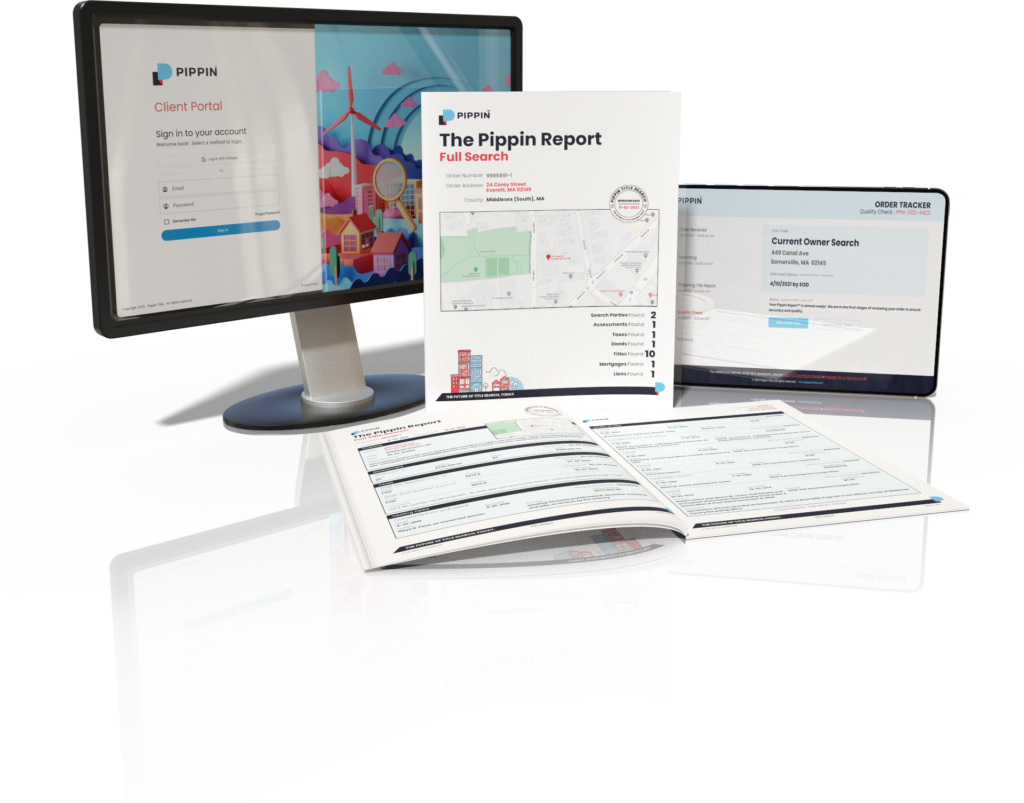
Easy to Use Dashboard
That integrates seamlessly with your existing workflows for simplified ordering, tracking, and invoicing.
Lightning-fast Service
For less hassle and delay; we’ll deliver your results in record time.
Always There For You
Thanks to support from our team of title search experts.
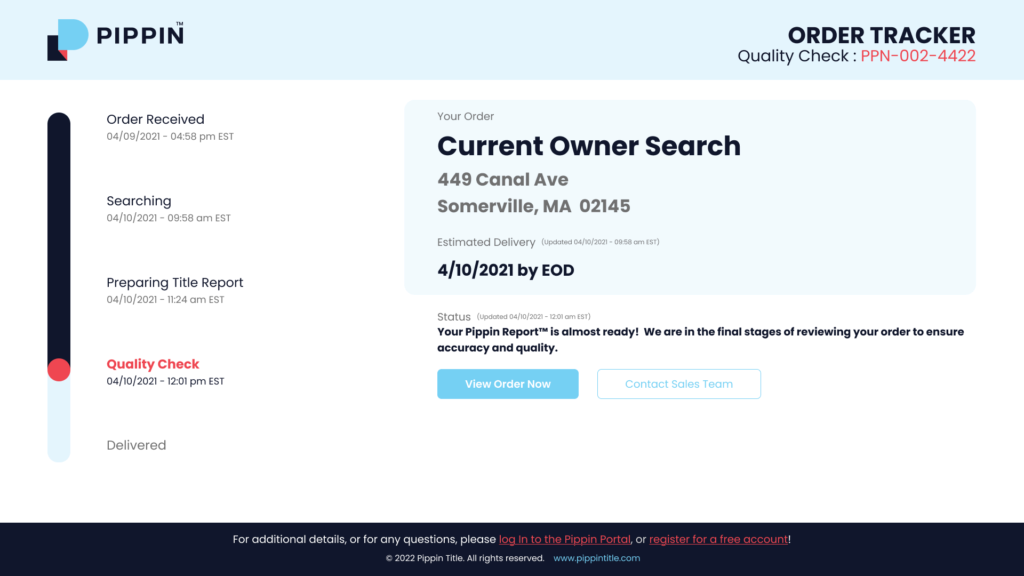
Real-time Order Tracking
So you can access the status of your order 24 hours a day, 7 days a week.
Standard Format Reports
That are backed by our rigorous quality control process.
Local Expertise On-Demand
Thanks to our nationwide network of ground searchers and robust search capabilities.
Do your next title search with Pippin.
Forget chasing after ground searchers and poring over documents. With our proprietary search technology, reliable searcher network, and rigorous quality control, you get accurate, commitment-ready reports every time – fast.
Leveraging advance technologies, like AI, enables Pippin to provide title services in revolutionary ways. Below are some examples of how we can change your everyday experience in title. These are things you only get with Pippin Title.
“We appreciate the help Pippin Title has provided us with numerous title searches. Pippin Title is very responsive to any issues and easy to work with.”
Tallent Title Group
“When partnering up with another company, communication is key. Pippin has this down to a science. It is so refreshing to know that a vendor is listening to our company’s wants and needs and will implement our requests in a seamless manner. We couldn’t be happier and are excited to continue to work with Pippin.”
ANS Title
“Pippin Title has consistently been very quick with their responses and their turnaround times from the time we have submitted a title request to them. Our team has literally had nothing but good and positive experiences with Pippin Title and will undoubtedly continue to use Pippin for all of our many Title needs!”
Hutton Law
“We know if we need a vendor to get a complete search even in the most rural areas, we can count on Pippin to get that back to us on time, correct, and for a decent price.”
Old Republic Title
“We have had a first-rate experience with Pippin. Their customer service is second to none. The portal for order requests is easy to navigate and very user friendly. The title reports provided are comprehensive. If we have to request additional documents, they are quick with their retrievals. They are extremely responsive and a pleasure to partner with. I recommend Pippin to anyone needing residential or commercial search services.”
Investor’s Title
“Easy Knock has been working with Pippin Title for over a year now and are extremely happy with the quality of data and level of service provided. The portal is very easy to use, the response times are faster than other providers, and the results are accurate. The team is very responsive to any questions and reaches out for clarifications on orders. The team at Pippin built an API solution to assist with automation at our end. We would highly recommend Pippin.”
If you still have general questions, fill out the form below to contact a Pippin Title rep.
By providing a telephone number and submitting this form you are consenting to be contacted by SMS text message. Message & data rates may apply. You can reply STOP to opt-out of further messaging.