
Autonomous vehicle developers, OEMs, and research institutions are acquiring proving ground sites against technology development timelines that compress due diligence into windows the title complexity of these sites doesn’t support. Former automotive testing facilities, decommissioned military airfields, and large-scale industrial parcels carry layered recorded instrument histories that reflect every operator, every government agency, and every financing arrangement that touched the land before the current transaction. Development agreements binding prior operators to municipal obligations that transferred without formal assumption. Federal surplus land deed restrictions from base closure conveyances requiring agency consent before permitted use can change. Environmental deed restrictions from prior fuel and industrial operations that conflict with new infrastructure requirements. Multi-parcel boundary discrepancies introduced when sites were assembled across different surveys and legal descriptions. Pippin Title provides specialised title search services for autonomous vehicle testing facility acquisitions that examine the full recorded instrument history behind these sites so every encumbrance is identified before the project is committed.






Autonomous vehicle testing facilities occupy a narrow category of large, operationally specific parcels with title histories that reflect prior automotive, military, and industrial use across multiple ownership periods. A standard commercial title search isn’t configured for that history.
The market for autonomous vehicle testing infrastructure is moving quickly. Waymo’s $220 million acquisition of the former Chrysler proving ground in Surprise, Arizona in 2026 is the most visible example of a transaction type that is becoming more common as AV deployment scales and the demand for dedicated, access-restricted testing environments grows. These transactions are closing under competitive pressure, and the due diligence timeline rarely reflects the title complexity of the sites being acquired.
Former proving grounds are the most commercially attractive AV testing candidates because they already carry the surface variety, perimeter infrastructure, and geographic isolation that controlled vehicle testing requires. They also carry the recorded instrument history of every operator who used the site before the current buyer arrived. A development agreement recorded between a prior automotive manufacturer and the host municipality, committing the site to specific land use conditions and infrastructure obligations, binds every subsequent owner unless formally novated. Where the site passed through a shell company or intermediate holding entity before reaching the current transaction, confirming the chain of obligation transfer requires examination across all intervening ownership periods. That examination can’t be skipped because the timeline is tight.
Former military sites introduce a different problem. Federal surplus land conveyances under the Base Realignment and Closure process carry deed restrictions that permanently constrain permitted use, require federal agency consent for certain land use changes, and include reverter clauses that return the property to federal ownership if conditions are violated. GoMentum Station, the AV testing facility developed at the former Concord Naval Weapons Station in California, is a real-world example of exactly this instrument category. Those restrictions are recorded against the real property and bind every owner regardless of how many transactions have occurred since the original federal conveyance.
Pippin Title examines the full recorded instrument history behind natural hazard zone properties: government-generated post-disaster liens and assessments, FEMA acquisition and mitigation deed restrictions, force-placed insurance instruments, mandatory hazard designation disclosure records, and all standard recorded encumbrances affecting ownership, insurability, and financing eligibility. You get the complete picture before the transaction proceeds.
The most consequential title risks in a proving ground acquisition don’t arise from the current ownership period. They arise from what prior operators, government agencies, and municipalities recorded against the site long before the current transaction was contemplated.
Development agreements recorded between prior site owners and host municipalities are among the most consistently overlooked instruments in AV facility acquisitions. These agreements are negotiated as conditions of prior land use approvals or public infrastructure investment and recorded against the real property with the same legal force as a deed restriction. They can commit the site owner to road access obligations, environmental monitoring requirements, infrastructure maintenance programmes, or land use limitations that persist regardless of ownership change. Where a site passed from an original automotive manufacturer through a corporate restructuring and then to an intermediate holding entity before reaching the current seller, each of those transfers created an opportunity for the development agreement obligations to carry forward without formal assumption. A buyer who acquires without confirming that chain of obligation is acquiring encumbrances the seller may not even be aware of.
Federal surplus land deed restrictions from Base Realignment and Closure conveyances are a distinct and senior recorded obligation category on former military testing sites. The Department of Defense conveys closed base land by quitclaim deed under conditions that specify permitted uses, require written federal agency consent before certain land use changes, and include reverter provisions that return the property to federal ownership if conditions are breached. Those restrictions survive every subsequent conveyance and bind every subsequent owner. For an AV developer acquiring a former military airfield or weapons station for testing use, confirming the full scope of those restrictions and whether the intended use is permitted under the original federal conveyance is a real estate title search function with direct consequences for the project’s viability.
Pippin Title traces the full chain of title across all prior ownership periods, examines development agreement instruments and assumption records, and identifies all federal surplus land deed restrictions and reverter clauses affecting the site.
Large proving ground sites are almost always assembled from multiple parcels, carry environmental deed restrictions from prior fuel and industrial operations, and are frequently subject to long-term access and sublicence instruments that create recorded interests alongside the fee ownership record.
AV testing facilities require substantial, contiguous land areas. The sites that offer the right combination of scale, geometry, and infrastructure are almost always assembled from multiple separately recorded parcels acquired at different times under different legal descriptions and surveyed to different standards. Where those parcels were assembled without a formal boundary reconciliation and replat, discrepancies between recorded legal descriptions and current physical boundaries persist in the title record. Those discrepancies affect the insurability of the site as a unified parcel and the ability to secure lender financing against it. Identifying them requires examining the full instrument history of each component parcel individually, not just the most recent deed in the chain.
Environmental deed restrictions from prior fuel storage, test track surface treatment, and vehicle testing operations are a recurring title category on proving ground sites that requires separate examination from the Phase I environmental assessment process. Where a prior operator stored petroleum products or operated fuel dispensing infrastructure on the site, state environmental agencies may have recorded deed restrictions as conditions of prior remediation or closure programmes. A restriction prohibiting excavation below a defined depth on a former fuel depot area of the proving ground can conflict directly with foundation, conduit, or charging infrastructure requirements for a new AV testing installation. Finding that restriction before the infrastructure design is finalised is materially cheaper than finding it after.
Long-term ground leases with research institutions, sublicence agreements with technology partners, and access instruments recorded in favour of adjacent operators create recorded interests alongside the fee ownership record that define who else has legally established rights to use the site and on what terms. Pippin Title examines multi-parcel boundary records, environmental deed restrictions from prior operations, and all recorded access and sublicence instruments to confirm the full scope of third-party interests affecting the site.
Development agreement obligations from prior automotive manufacturers, federal surplus land deed restrictions from BRAC conveyances, environmental deed restrictions from prior fuel operations, and multi-parcel boundary discrepancies are the recorded interests that define autonomous vehicle testing facility acquisitions. Pippin Title’s real estate title search services identify every one of them before your transaction closes.


We combine that deep domain knowledge with cutting-edge technology, using AI-assisted tools to generate commitments at record speed.
No more manual compiling or rekeying. Just clean, accurate data delivered directly into your workflow.
Whether you’re acquiring land, redeveloping a corridor, or launching a public infrastructure project ,Pippin gives you the clarity to move forward with confidence, and the tech to move faster.


We’re known in the industry for our accuracy, speed and transparent process, but when you choose Pippin for your title search, you’ll also get:
That integrates seamlessly with your existing workflows for simplified ordering, tracking, and invoicing.
For less hassle and delay; we’ll deliver your results in record time.
Thanks to support from our team of title search experts.
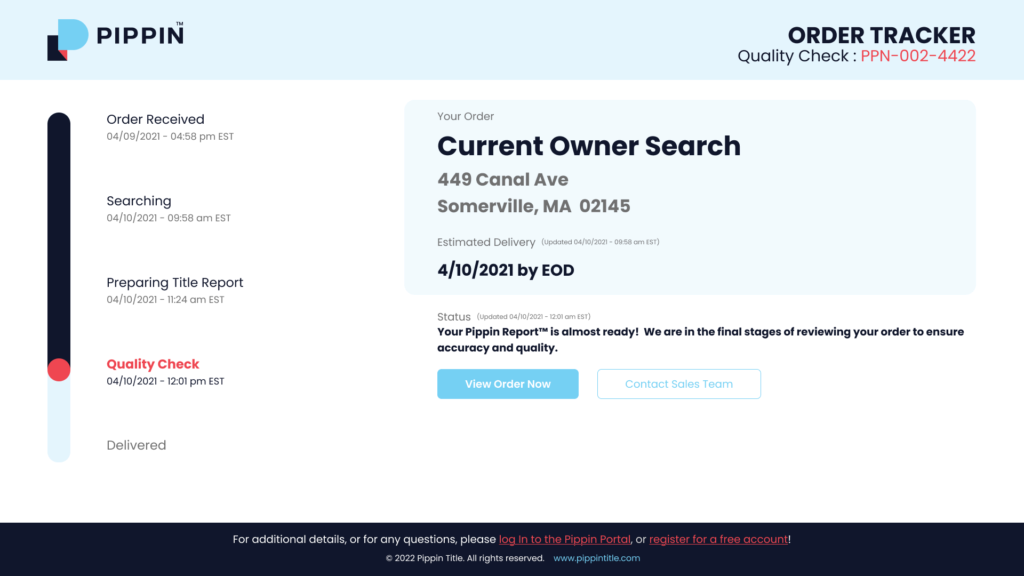
So you can access the status of your order 24 hours a day, 7 days a week.
That are backed by our rigorous quality control process.
Thanks to our nationwide network of ground searchers and robust search capabilities.
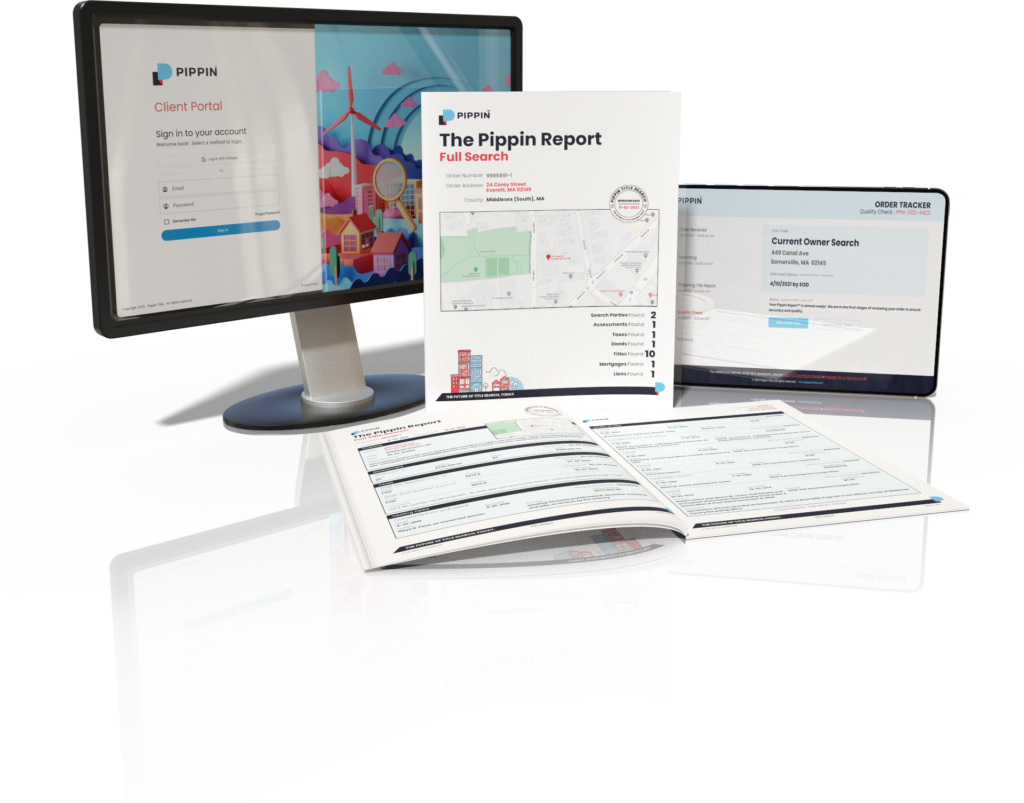
That integrate seamlessly with your existing workflows for simplified ordering, tracking and invoicing.




Leveraging advance technologies, like AI, enables Pippin to provide title services in revolutionary ways. Below are some examples of how we can change your everyday experience in title. These are things
you only get with Pippin Title.








If you still have general questions, fill out the form below to contact a Pippin Title rep.
By providing a telephone number and submitting this form you are consenting to be contacted by SMS text message. Message & data rates may apply. You can reply STOP to opt-out of further messaging.