A Parking Lot Is One of the Simplest Assets to Operate. Its Title Record Is Rarely Simple.
Surface parking lots attract investors precisely because the operating model is straightforward. What the title record carries is a different matter. Reciprocal easement agreements obligating the owner to provide parking to adjacent office, retail, or residential buildings, negotiated as conditions of surrounding development approvals and running with the land in perpetuity. Municipal concession instruments recording pricing obligations, public access requirements, and operating hour restrictions that survive every subsequent ownership change. Development restriction encumbrances tying the lot’s redevelopment potential to the entitlement position of an adjacent building the current owner has no relationship with. Shared access instruments governing how traffic enters and exits the site. None of these appear on the face of a deed, and all of them define what the lot actually is and what a buyer is acquiring with it. Pippin Title provides specialised surface parking lot title search services that examine the full recorded instrument history behind parking assets so every encumbrance affecting value, use, and development potential is identified before you close.
Title Research That Reflects What a Surface Parking Lot Actually Carries
Surface parking lots sit at the intersection of urban land use, shared access law, and development rights complexity. The commercial property due diligence has to reflect that, not treat the lot as a simple parcel with a deed and a lien search.
Parking lot investment has attracted significant capital in recent years as investors recognise surface lots in urban and suburban markets as both income-generating assets and optionality plays on future development. That investment activity has compressed the due diligence timeline on surface lot acquisitions and created a pattern where the title research is treated as a formality rather than a substantive exercise.
It isn’t. Surface parking lots in established markets are disproportionately likely to carry recorded instruments that directly affect what a buyer can do with the asset after closing. A lot in a downtown block almost certainly serves adjacent buildings under recorded easement arrangements that were put in place when those buildings were developed, often decades ago. Those easements define the minimum number of spaces that must remain available, the hours during which access must be maintained, and in some cases the pricing structure that applies to reserved spaces. The current operator may be honouring those obligations without knowing they are recorded against the real property rather than governed by a simple lease arrangement that can be terminated. A buyer who acquires without identifying them inherits every obligation attached to them.
The development optionality that makes surface lots attractive to investors is also where the most material title risks sit. A lot whose redevelopment potential is constrained by a recorded easement that requires it to continue serving an adjacent building’s parking requirement can’t be repositioned until that easement is addressed. A lot that sits within a zoning classification tied to surrounding development entitlements rather than its own permitted use faces a compliance exposure that changes with its neighbours. These are conditions documented in the recorded instrument history, not on the surface.
Pippin Title examines the full recorded instrument history behind surface parking lot acquisitions: reciprocal easement obligations, shared access instruments, municipal concession agreements, development restriction encumbrances, zoning classifications, and all recorded liens and interests across the complete property record. You get a complete picture of what the asset carries before the investment is committed.
Reciprocal Easements, Shared Access Rights, and Development Restriction Encumbrances
The recorded instruments that most affect a surface parking lot’s value and development potential are almost never the ones that appear first in a title search. They require dedicated examination of the easement and restriction history, not just the ownership chain.
Reciprocal parking easements are negotiated as conditions of surrounding development approvals and recorded against both the parking parcel and the property they benefit. For a surface lot in an urban or suburban market, those easements can require the owner to maintain a defined number of spaces in continuous operation, restrict the hours during which the lot can be closed or repurposed, and impose maintenance and lighting standards that run with the land regardless of how many times the parking parcel changes hands. Where a lot is the sole or primary source of required parking for an adjacent office or retail building under a recorded shared parking agreement, that obligation constrains the lot’s redevelopment potential until the benefiting building’s entitlement position changes. That constraint doesn’t appear on a zoning map or a current deed. It sits in the recorded easement, and it only surfaces if someone examines the full instrument history rather than confirming current ownership and running a standard lien search.
Development restriction encumbrances tied to the entitlements of surrounding parcels create a further category of risk specific to surface lots in established urban markets. Where a lot’s zoning classification derives from the development approval of an adjacent building, changes in that building’s use or ownership can affect the lot’s permitted use without any instrument being recorded against the parking parcel itself. Identifying whether the lot’s current zoning position is freestanding or derivative of surrounding entitlements requires examination of the applicable zoning designation and any conditions attached to prior land use approvals affecting the broader block.
Pippin Title examines all recorded reciprocal easements, shared parking instruments, development restriction encumbrances, and zoning and land use designations to confirm what the asset actually permits and what obligations a buyer is acquiring with it.
Municipal Concession Agreements, Recorded Liens, and Prior Operator Obligations
Prior owners of surface parking lots routinely enter into recorded agreements with municipalities and private operators that define how the asset must be operated long after those owners have moved on. Identifying those instruments before closing is commercial property due diligence at its most consequential.
Municipal concession arrangements are a common feature of surface lot title records in markets where local authorities have used parking assets as tools of downtown management, public financing, or development incentive programmes. Where a lot was previously acquired, improved, or operated with the benefit of a municipal arrangement, the conditions attached to that arrangement are frequently recorded against the real property and bind every subsequent owner. Those conditions can restrict permitted pricing structures, require minimum hours of public access, impose maintenance standards enforceable by the municipality, or include right of first refusal provisions that affect the owner’s ability to sell without triggering a municipal option. They don’t terminate when the lot changes hands. They require active identification and legal assessment before a buyer can understand what operational constraints they are acquiring alongside the title.
Private operator agreements and management contracts recorded against parking assets present a parallel category of encumbrance. Where a parking management company has recorded an operating agreement, a right of first refusal tied to a management contract, or a revenue sharing instrument against the real property, those instruments may survive the sale and affect a new owner’s ability to change operators, alter pricing, or reposition the asset. These are not lease arrangements that expire. They are recorded encumbrances that require examination and, where relevant, formal discharge before the asset can be freely operated under new ownership.
On the lien side, mechanic’s liens from prior resurfacing or drainage work, delinquent real property tax and municipal assessment obligations, and judgment liens recorded against prior owners all require confirmation of discharge. Pippin Title researches municipal concession agreements, private operator instruments, rights of first refusal, and all recorded lien and judgment interests to ensure the full encumbrance picture is known before any parking lot transaction proceeds.
Surface Parking Lot Due Diligence Means Reading the Recorded History, Not Just the Deed.
Reciprocal easement obligations, municipal concession agreements, development restriction encumbrances, and private operator instruments recorded by prior owners don’t terminate on a sale. Whether you’re acquiring a surface lot as a long-term income asset, a development optionality play, or a portfolio addition, Pippin Title’s title search services ensure every recorded interest is identified before you commit.
Our Team Specializes In
Identifying recorded reciprocal easement agreements and shared parking obligations benefiting adjacent commercial, office, or residential users across the full instrument history of the parking parcel
Examining development restriction encumbrances and zoning classifications tied to surrounding development entitlements rather than the parking parcel’s own permitted use designation
Researching municipal concession agreements, public access easements, pricing restriction instruments, and right of first refusal provisions recorded in favour of local authorities
Reviewing private operator agreements, management contracts, revenue sharing instruments, and operator rights of first refusal recorded against parking assets
Confirming all recorded liens, judgment interests, mechanic’s liens, delinquent tax assessments, and prior financing instruments affecting the parking parcel
Examining shared access instruments, ingress and egress easements, and site circulation arrangements governing how traffic accesses the lot and on what conditions
Supporting buyers, investors, developers, lenders, and law firms in surface parking lot acquisitions, portfolio transactions, urban infill redevelopment plays, and parking asset financing
But it’s not just
about expertise:
It’s about efficiency.
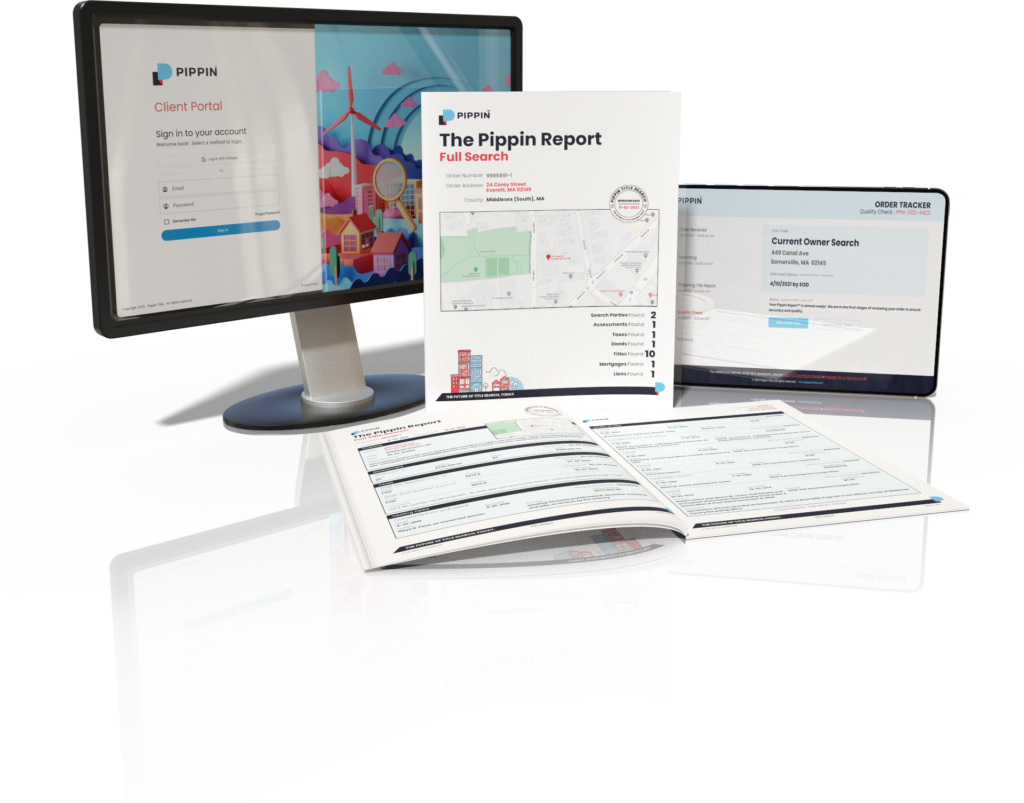
We combine that deep domain knowledge with cutting-edge technology, using AI-assisted tools to generate commitments at record speed.
No more manual compiling or rekeying. Just clean, accurate data delivered directly into your workflow.
Whether you’re acquiring land, redeveloping a corridor, or launching a public infrastructure project ,Pippin gives you the clarity to move forward with confidence, and the tech to move faster.
Watch every step of your title search be turned around in as little as 24 hours.
We’re known in the industry for our accuracy, speed and transparent process, but when you choose Pippin for your title search, you’ll also get:
Easy to Use Dashboard
That integrates seamlessly with your existing workflows for simplified ordering, tracking, and invoicing.
Lightning-fast Service
For less hassle and delay; we’ll deliver your results in record time.
Always There For You
Thanks to support from our team of title search experts.
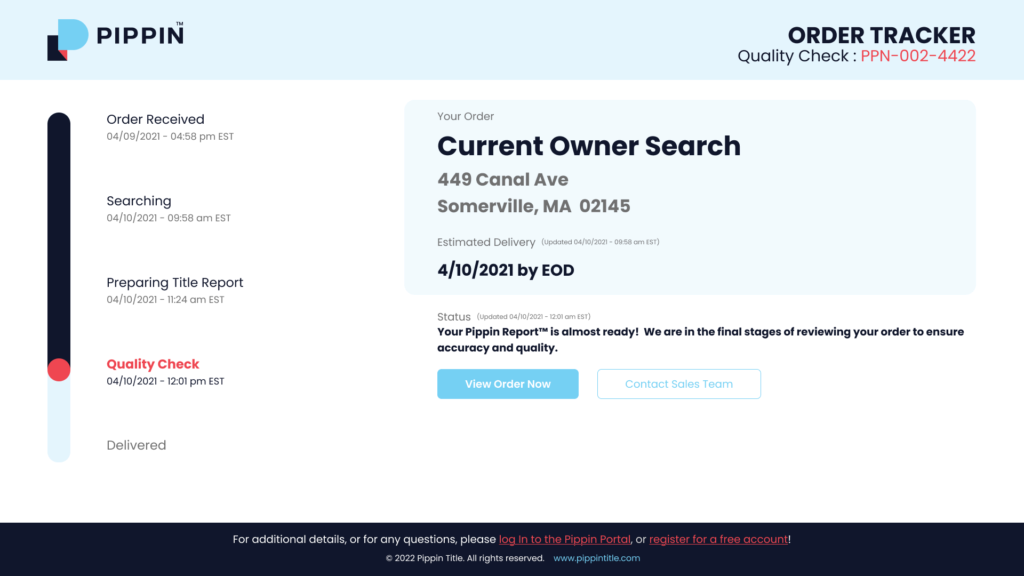
Real-time Order Tracking
So you can access the status of your order 24 hours a day, 7 days a week.
Standard Format Reports
That are backed by our rigorous quality control process.
Local Expertise On-Demand
Thanks to our nationwide network of ground searchers and robust search capabilities.
Do your next title search with Pippin.
Forget chasing after ground searchers and poring over documents. With our proprietary search technology, reliable searcher network, and rigorous quality control, you get accurate, commitment-ready reports every time – fast.
Leveraging advance technologies, like AI, enables Pippin to provide title services in revolutionary ways. Below are some examples of how we can change your everyday experience in title. These are things you only get with Pippin Title.
“We appreciate the help Pippin Title has provided us with numerous title searches. Pippin Title is very responsive to any issues and easy to work with.”
Tallent Title Group
“When partnering up with another company, communication is key. Pippin has this down to a science. It is so refreshing to know that a vendor is listening to our company’s wants and needs and will implement our requests in a seamless manner. We couldn’t be happier and are excited to continue to work with Pippin.”
ANS Title
“Pippin Title has consistently been very quick with their responses and their turnaround times from the time we have submitted a title request to them. Our team has literally had nothing but good and positive experiences with Pippin Title and will undoubtedly continue to use Pippin for all of our many Title needs!”
Hutton Law
“We know if we need a vendor to get a complete search even in the most rural areas, we can count on Pippin to get that back to us on time, correct, and for a decent price.”
Old Republic Title
“We have had a first-rate experience with Pippin. Their customer service is second to none. The portal for order requests is easy to navigate and very user friendly. The title reports provided are comprehensive. If we have to request additional documents, they are quick with their retrievals. They are extremely responsive and a pleasure to partner with. I recommend Pippin to anyone needing residential or commercial search services.”
Investor’s Title
“Easy Knock has been working with Pippin Title for over a year now and are extremely happy with the quality of data and level of service provided. The portal is very easy to use, the response times are faster than other providers, and the results are accurate. The team is very responsive to any questions and reaches out for clarifications on orders. The team at Pippin built an API solution to assist with automation at our end. We would highly recommend Pippin.”
If you still have general questions, fill out the form below to contact a Pippin Title rep.
By providing a telephone number and submitting this form you are consenting to be contacted by SMS text message. Message & data rates may apply. You can reply STOP to opt-out of further messaging.