When it comes to complex corridor research, Pippin Title delivers clarity where others stall. Our team brings unmatched expertise in railroad title searches, combining advanced GIS tools, archived historical records, and dedicated title analysts to uncover even the most obscure easements, conveyances, and right-of-way issues. Whether you’re dealing with active rail, abandoned lines, or overlapping interests, we help you move forward with confidence.
Specialized title solutions for one of America’s most complex property types.
Railroad property title searches aren’t like your standard real estate searches. With records often stretching back 100 to 200 years and ownership tangled in corporate mergers, government grants, and historical claims, they require a unique blend of legal insight and deep historical research.
At Pippin Title, we combine advanced search technology, national coverage, and unmatched archival expertise to deliver accurate, commitment-ready reports for railroad property across all 50 states.
Coast-to-Coast Railroad Clarity
Our team handles everything from abandoned lines to legacy ownership and reversionary risks.
Most railroad title searches begin with a mystery: who actually owns this land? Small rail lines often folded or were absorbed by larger companies without any formal transfer being recorded.
Just because the county records list Consolidated Railroad doesn’t mean that company holds the rights today.
Pippin Title’s commercial title specialists go beyond courthouse records, consulting the National Archives and historical railroad documents to trace successor ownership and verify title.
Understanding Reversionary Interest
19th-century clauses can still impact 21st-century projects.
During the railroad boom of the 1800s, many landowners sold property to railroad companies under reverter clauses, legal conditions that said the land would revert back to the original owners or their heirs if it was no longer used for railroad purposes.
Today, these historic clauses still carry legal weight. For projects like Rails-to-Trails, this creates risk: if a reversionary interest still exists, an heir could claim ownership, derailing your project with expensive litigation. That’s why Pippin Title searches all the way back to the original conveyance to uncover and flag any reverter clauses.
Railroad Title Searches Get Complex. We Make Them Clear.
Courthouse records are just the beginning. Railroad title searches demand deep historical insight, national reach, and precision research — and that’s exactly what we deliver.
Our Team Specializes In
Conducting 100- to 200-year historical title reviews
Tracing railroad mergers and successor ownership
Accessing the National Archives for supporting documentation
Investigating reverter clauses and potential claims
But it’s not just
about expertise:
It’s about efficiency.
We combine that deep domain knowledge with cutting-edge technology, using AI-assisted tools to generate commitments at record speed.
No more manual compiling or rekeying. Just clean, accurate data delivered directly into your workflow.
Whether you’re acquiring land, redeveloping a corridor, or launching a public infrastructure project ,Pippin gives you the clarity to move forward with confidence, and the tech to move faster.
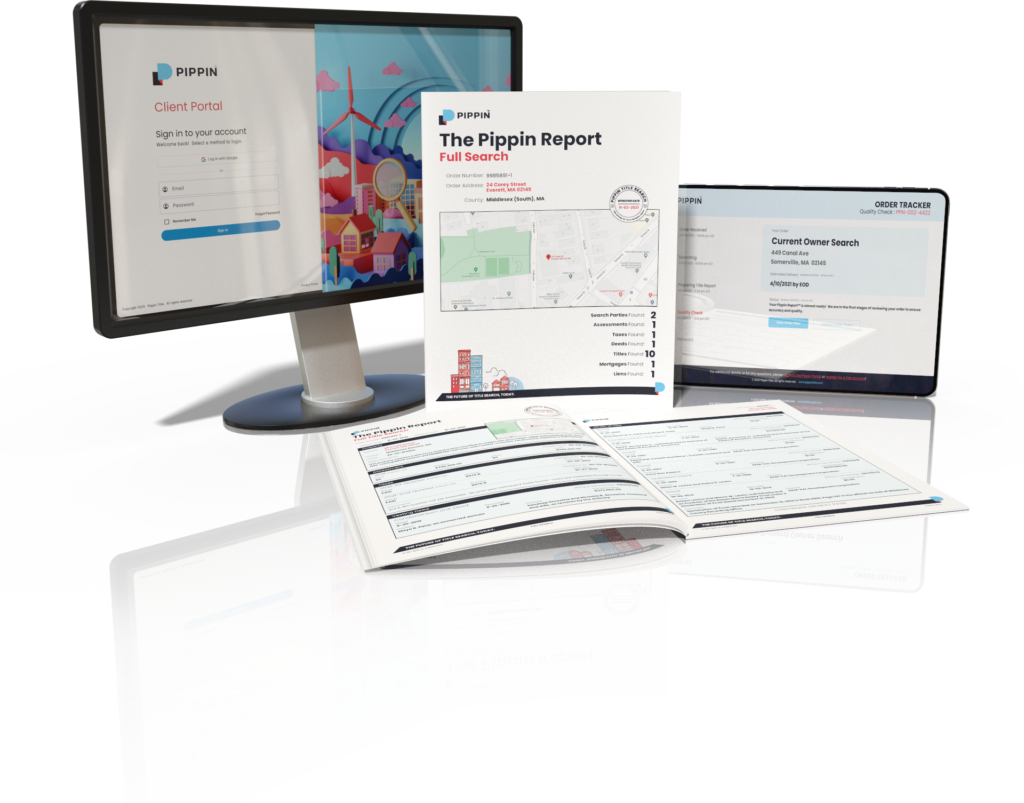
Watch every step of your title search be turned around in as little as 24 hours.
We’re known in the industry for our accuracy, speed and transparent process, but when you choose Pippin for your title search, you’ll also get:
Easy to Use Dashboard
That integrates seamlessly with your existing workflows for simplified ordering, tracking, and invoicing.
Lightning-fast Service
For less hassle and delay; we’ll deliver your results in record time.
Always There For You
Thanks to support from our team of title search experts.
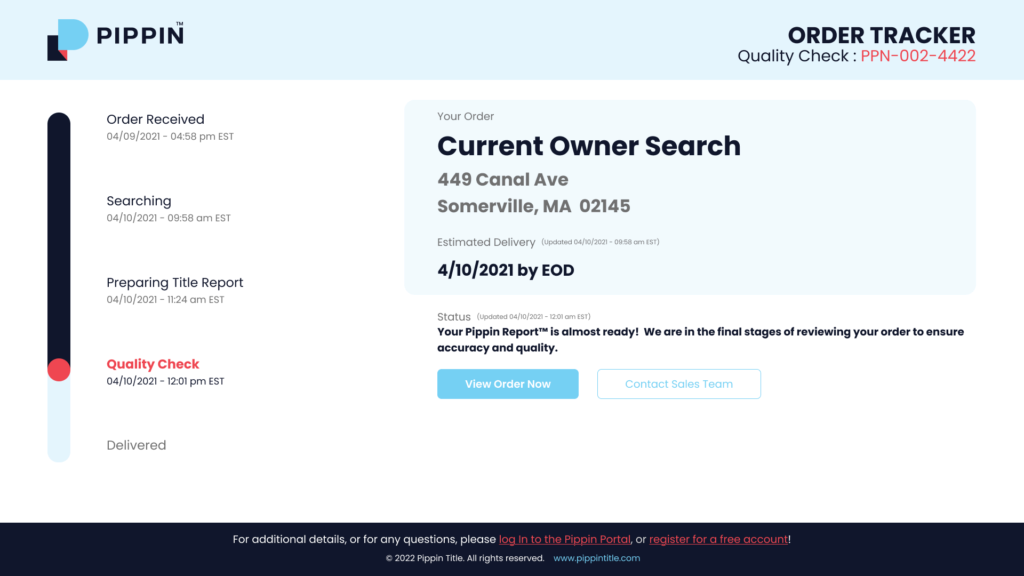
Real-time Order Tracking
So you can access the status of your order 24 hours a day, 7 days a week.
Standard Format Reports
That are backed by our rigorous quality control process.
Local Expertise On-Demand
Thanks to our nationwide network of ground searchers and robust search capabilities.
Do your next title search with Pippin.
Forget chasing after ground searchers and poring over documents. With our proprietary search technology, reliable searcher network, and rigorous quality control, you get accurate, commitment-ready reports every time – fast.
Leveraging advance technologies, like AI, enables Pippin to provide title services in revolutionary ways. Below are some examples of how we can change your everyday experience in title. These are things you only get with Pippin Title.
“We appreciate the help Pippin Title has provided us with numerous title searches. Pippin Title is very responsive to any issues and easy to work with.”
Tallent Title Group
“When partnering up with another company, communication is key. Pippin has this down to a science. It is so refreshing to know that a vendor is listening to our company’s wants and needs and will implement our requests in a seamless manner. We couldn’t be happier and are excited to continue to work with Pippin.”
ANS Title
“Pippin Title has consistently been very quick with their responses and their turnaround times from the time we have submitted a title request to them. Our team has literally had nothing but good and positive experiences with Pippin Title and will undoubtedly continue to use Pippin for all of our many Title needs!”
Hutton Law
“We know if we need a vendor to get a complete search even in the most rural areas, we can count on Pippin to get that back to us on time, correct, and for a decent price.”
Old Republic Title
“We have had a first-rate experience with Pippin. Their customer service is second to none. The portal for order requests is easy to navigate and very user friendly. The title reports provided are comprehensive. If we have to request additional documents, they are quick with their retrievals. They are extremely responsive and a pleasure to partner with. I recommend Pippin to anyone needing residential or commercial search services.”
Investor’s Title
“Easy Knock has been working with Pippin Title for over a year now and are extremely happy with the quality of data and level of service provided. The portal is very easy to use, the response times are faster than other providers, and the results are accurate. The team is very responsive to any questions and reaches out for clarifications on orders. The team at Pippin built an API solution to assist with automation at our end. We would highly recommend Pippin.”
If you still have general questions, fill out the form below to contact a Pippin Title rep.
By providing a telephone number and submitting this form you are consenting to be contacted by SMS text message. Message & data rates may apply. You can reply STOP to opt-out of further messaging.